
Window of Tolerance Guide
One of the main underlying issues therapy clients face, across reasons for seeking therapy, is difficulty regulating emotions. They may feel like they go from zero to 100 when faced with a stressor, hyper-vigilant, or out of control. Or, maybe they shut down and spend hours on their phones, allowing life to just happen to them, rather than engaging with the world around them. When people experience difficulty regulating their emotions, they’re often outside of their “Window of Tolerance.”
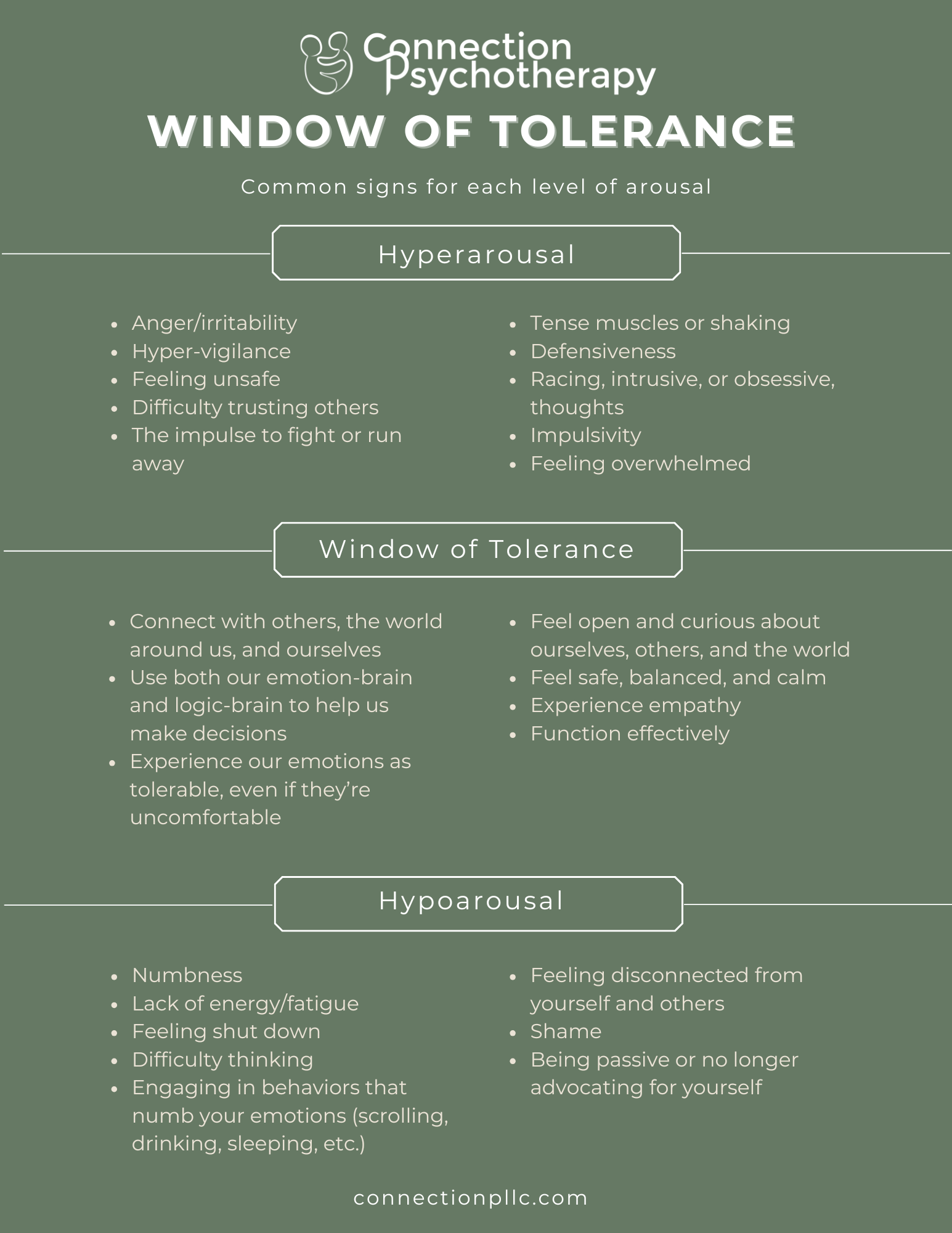
The Window of Tolerance is our optimal emotional zone, where we are able to handle life’s stressors effectively. When we’re within the Window of Tolerance, we’re typically the best version of ourselves. When we’re outside of our Window of Tolerance, we’re either “hyperaroused” or “hypoaroused.” Hyperarousal is what we more commonly call the “fight” or “flight” response, while hypoarousal is the “freeze” response.
The image below lists some common signs for each level of arousal:
So, why am I dysregulated in the first place?
There are an infinite number of reasons why we may become dysregulated. Usually, there is more than one factor at play in any given situation. Some common factors include:
Physical:
Pain
Illness
Exhaustion
Hunger
Being pregnant
Having recently experienced a major medical event/surgery (including giving birth)
Hormonal changes
Neurodivergence
Medications or substance use
Emotional:
Experiencing aversive emotions: anger, loneliness, frustration, sadness, disappointment, etc.
A history of trauma
Mental health concerns such as depression, anxiety, OCD, etc.
Environmental:
Work, home, relationship, and financial stressors
Loud noises, clutter, bright lights, etc.
We all become dysregulated sometimes, but if you’re finding that you’re dysregulated much of the time or that dysregulation is making it difficult to maintain relationships, work, or take care of yourself, then you may benefit from working on expanding your Window of Tolerance.
When I’m working with clients who could benefit from expanding their Window of Tolerance, I usually start with asking them to identify the signs that they are within their Window of Tolerance, hyperaroused, and hypoaroused. If they aren’t sure, then that’s the first assignment: for a week or two, pay attention to and write down the signs that you’re within your Window of Tolerance, hyperaroused, or hypoaroused.
Next, I have clients identify the more subtle signs that they’re headed towards the edges of their Window of Tolerance, headed on their way out to becoming dysregulated. These may be less intense versions of their experience when they’re dysregulated, but also may be things like: increased muscle tension, sweating, feeling antsy, etc. I ask clients to write these down, too, so they’re accessible.
Once clients have identified these signs and signals, we start working on reducing their distress and expanding their coping skill repertoire. Sometimes, our distress can be reduced by addressing the factors within our control. Are you hungry? Eat.
When we can’t easily address the factors contributing to our distress, we need to learn how to cope with the distress we’re experiencing. In order to do this, we need a repertoire of coping skills. Sometimes we can’t access certain ones (you probably can’t just go for a run every time you’re overwhelmed at work), and sometimes certain ones aren’t effective in that moment (stepping outside into the freezing cold doesn’t really work if you’re already outside in the freezing cold). So, I help clients build a toolbox of coping skills, to have many options.
Some of my go-to coping skills include:
54321: Breathing deeply throughout, name: 5 things you see in front of you, 4 things you hear, 3 things you’re touching, 2 things you smell, and 1 thing you taste.
TIPP Skills:
Temperature: stick your face in a bowl of ice water; stand outside in cold weather for a few seconds without a coat on; put an ice pack on your neck or belly; drink some ice water
Intense exercise: do some brief, intense exercise. This may look like 20 jumping jacks, 30 seconds of high-knees, dancing, or running up some stairs.
Paced breathing: engaging in deep breathing exercises that involve counting your breath. Examples include:
Box breathing: imagine creating a box with your breath, inhaling for a count of four, holding your breath for a count of four, exhaling for a count of four, holding for a count of four. Make as many “boxes” with your breath as you need.
578 breathing: inhale for a count of 5, hold your breath for a count of 7, and exhale for a count of 8.
Progressive muscle relaxation: breathing deeply throughout and starting with your feet, tense your muscles and hold for 5-10 seconds each, pausing in between each muscle group to imagine exhaling the stress. Work your way up from your feet all the way to your face.
Grounding:
Standing firmly on your feet, push with your hands against the wall. Sense into the sensation of being held up by your legs and the ground beneath you, while also exerting force on the wall.
Plant your feet on the ground and notice how it feels to be rooted into the ground underneath the soles of your feet.
Once clients have identified the signs they’re exiting or outside of their Window of Tolerance and built up their coping skills, I ask clients to consider which coping skills would be most effective if they’re hyper- or hypo-aroused, on their way to being hyper- or hypo-aroused, or within their Window of Tolerance. I ask clients to write this down and keep this list of coping skills with them, so they can refer to it as needed. You can use this fillable worksheet to do so.
This may seem simple on paper, but lived experience is usually more complex. It can be difficult to identify certain factors contributing to your dysregulation or remember to use your healthy coping skills, rather than leaning on your harmful ones. Doing this work with a therapist can help provide you new perspectives, identify reasons why you may be engaging in unhelpful patterns exacerbating your dysregulation, and support you in using more helpful coping strategies.
If you experience dysregulation and want some support in expanding your Window of Tolerance, please reach out to schedule a session.
About the Author
Rachel Mintz is a Licensed Clinical Social Worker (LCSW), Certified Sex Therapist (CST), and Perinatal Mental Health-Certified (PMH-C) therapist based in Chicago, and she’s the founder of Connection Psychotherapy. Rachel helps clients heal from trauma, address dissatisfaction with their sex lives, navigate pregnancy and postpartum struggles, reduce anxiety, and stop engaging in obsessive-compulsive behaviors. Rachel uses various evidence-based modalities, including CBT, ACT, EMDR, ERP, and Mindfulness.